Hopper sub-assembly line
Output up from 1,400 to 1,750 a week on a single day shift. Units per person per hour up 44%, from 9 to 13, and cycle time down 16%, from 300 to 252 seconds. Eight safety issues fixed and the 5S audit score up from 15 to 24.
The site builds coin-handling and payment equipment across many product lines, and one line alone had 308 variants. Demand was rising on some lines: one sub-assembly line had to go from 1,400 to 1,750 units a week to support a product ramp-up. Others had too many configurations to plan reliably, no formal maintenance routine, or recurring quality problems.
Each problem needed more than a quick fix. The people running the line had to understand why it was happening and own the new way of working, so the improvement would last after the week was over.
Alongside the Kaizen programme, we led the transfer of a multimillion-pound production facility from Germany to the UK: travelling to the German site, replicating the product lines, training operatives and setting productivity baselines. The same Kaizen methods then took efficiency beyond the original operation.
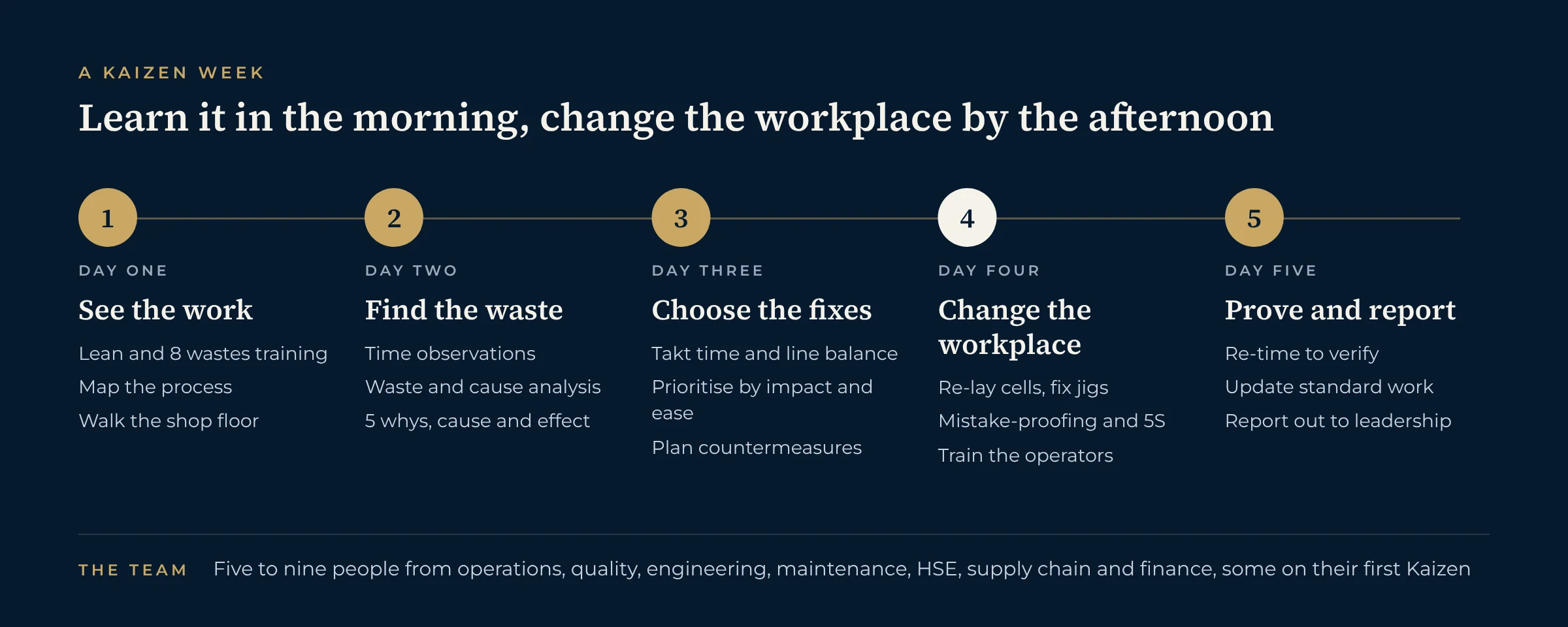
Every event ran over five days with a mixed team of five to nine people: operators, team leaders, quality, engineering, maintenance, HSE, supply chain and finance, some on their first Kaizen. Short training blocks each morning were put straight to work on the line.
Teams set the pace with takt time, balanced the work to it with load charts and standard work, and built playbooks for different crew sizes. Two-bin point-of-use systems, kitting and a dedicated material handler pulled parts to the line. Mistake-proofing, 5S and visual management (andon lights, shadow boards, floor markings and performance boards) made the new standard easy to follow and easy to check.
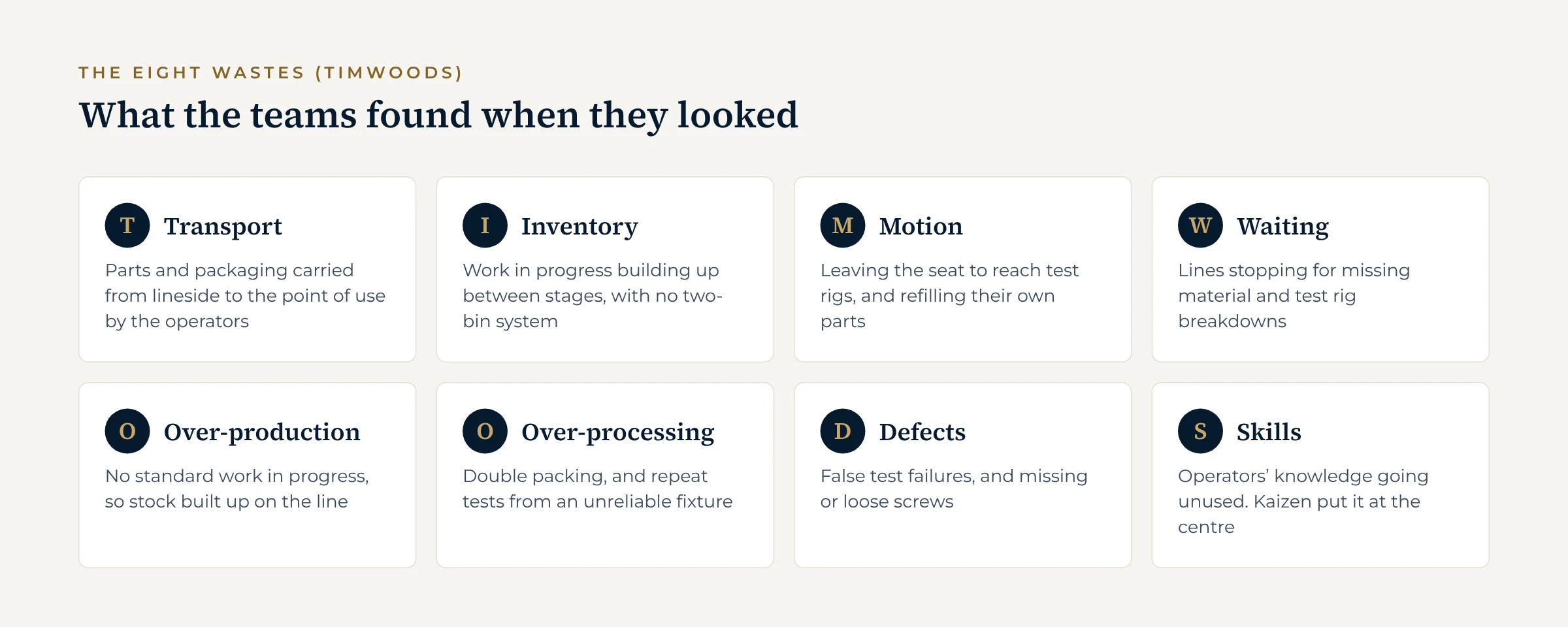
Teams learned the eight wastes, then audited their own lines to find them. Seeing waste in their own work, rather than in a classroom example, is what made the changes stick.
The rule was simple: if the team could change it during the week, they did. Ideas were tried on the line, re-timed to prove they worked, written into standard work and trained out to operators before the report-out.
Each week ended with a report-out to leadership and a newspaper of open actions with owners and dates, so nothing was left hanging.
Every event started with safety. Equipment was locked out before anyone worked on it, and safety issues were fixed during the week rather than added to a list. Replacing hand drivers with torque-set electric drivers also reduced the risk of repetitive strain.
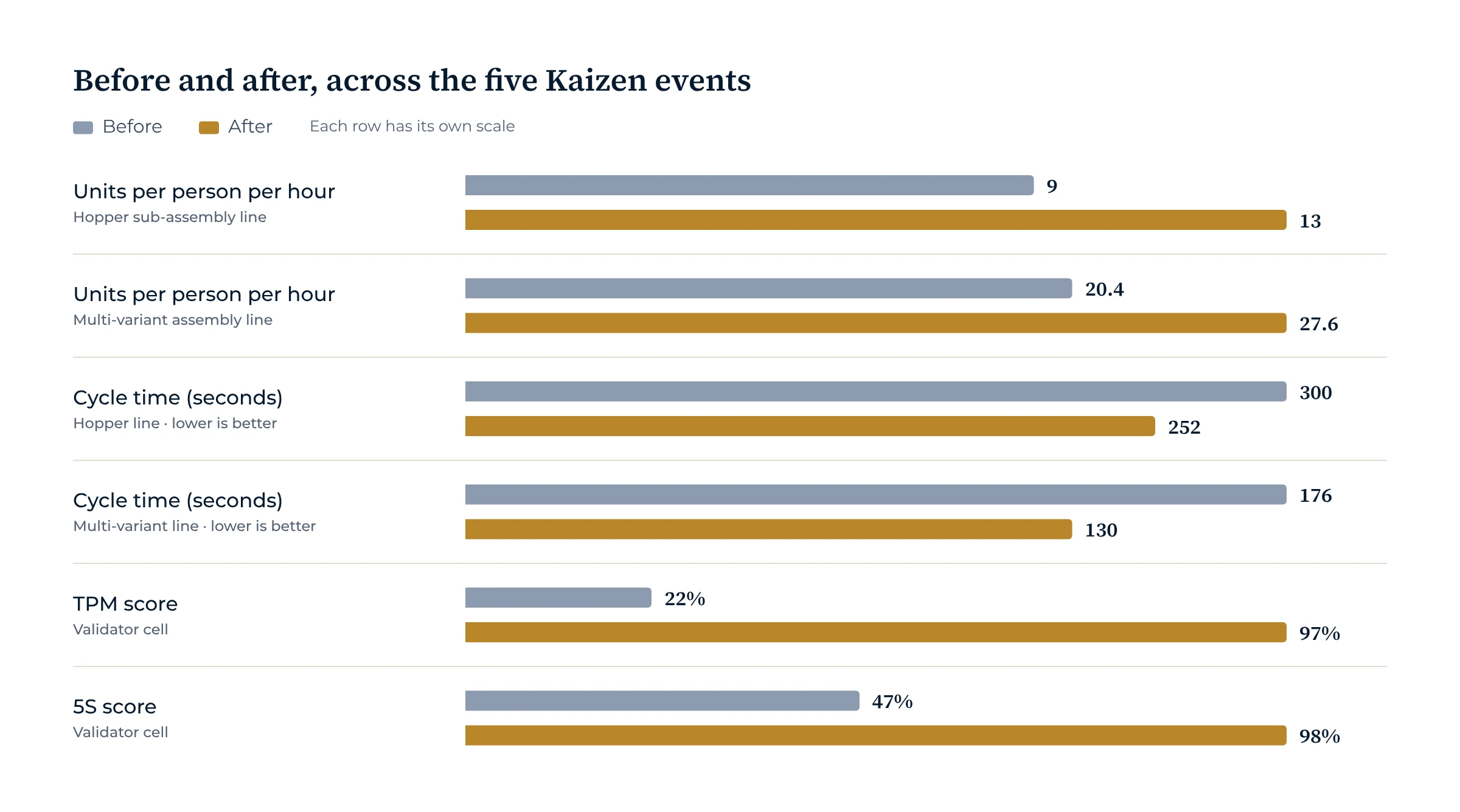
Output up from 1,400 to 1,750 a week on a single day shift. Units per person per hour up 44%, from 9 to 13, and cycle time down 16%, from 300 to 252 seconds. Eight safety issues fixed and the 5S audit score up from 15 to 24.
Cycle time down from 176 to 130 seconds and units per person per hour up from 20.4 to 27.6. Kitting removed around three minutes of part-chasing per order, and 8 m² of floor space was freed across three cells.
TPM score up from 22% to 97% and 5S from 47% to 98%. 64 issues red-tagged and 60 closed in the week, including every safety item, with daily, weekly, preventive and predictive checks now in place.
Showed that 80% of test failures were genuine and 20% process-related, then mistake-proofed coin insertion. 10 of 11 actions were completed in the week, targeting first pass yield up from 89% to 94%.
Screw counters with go/no-go lights, torque-set electric drivers in place of hand drivers (reducing strain risk) and 38% fewer driver types on the problem stages, targeting an 80% reduction in missing and loose screws.
Client and product details have been anonymised. Results are drawn from the Kaizen events’ own report-outs; targets are labelled as such.
Don’t accept that a layout can’t change, even on a largely automated line.
Input from the people on the line had the biggest impact. Fresh eyes brought new ideas.
Find the problem where it happens, and listen to the people who do the work.
Validate targets and prove concepts before the week, so equipment can be ordered in time.
We run Kaizen events and Lean training that build lasting improvement capability on the shop floor. Let’s talk about where your operation could start.