Case study 01 · Construction and energy infrastructure

Aligning the business to meet future growth

With its pipeline set to roughly double the size of the business, a UK power transmission and distribution business needed the right foundations in place to sustain that growth. We started with the executive team to build a shared strategic direction, then worked with the wider business to turn it into prioritised, owned and measurable change.

Download the PDF Talk to us about growth
Client
Power transmission and distribution business, UK infrastructure contractor
Sector
Construction and energy infrastructure
Services
Strategic alignment, transformation design, workshop facilitation, governance
Engagement
12+ months, from mid-2024
At a glance
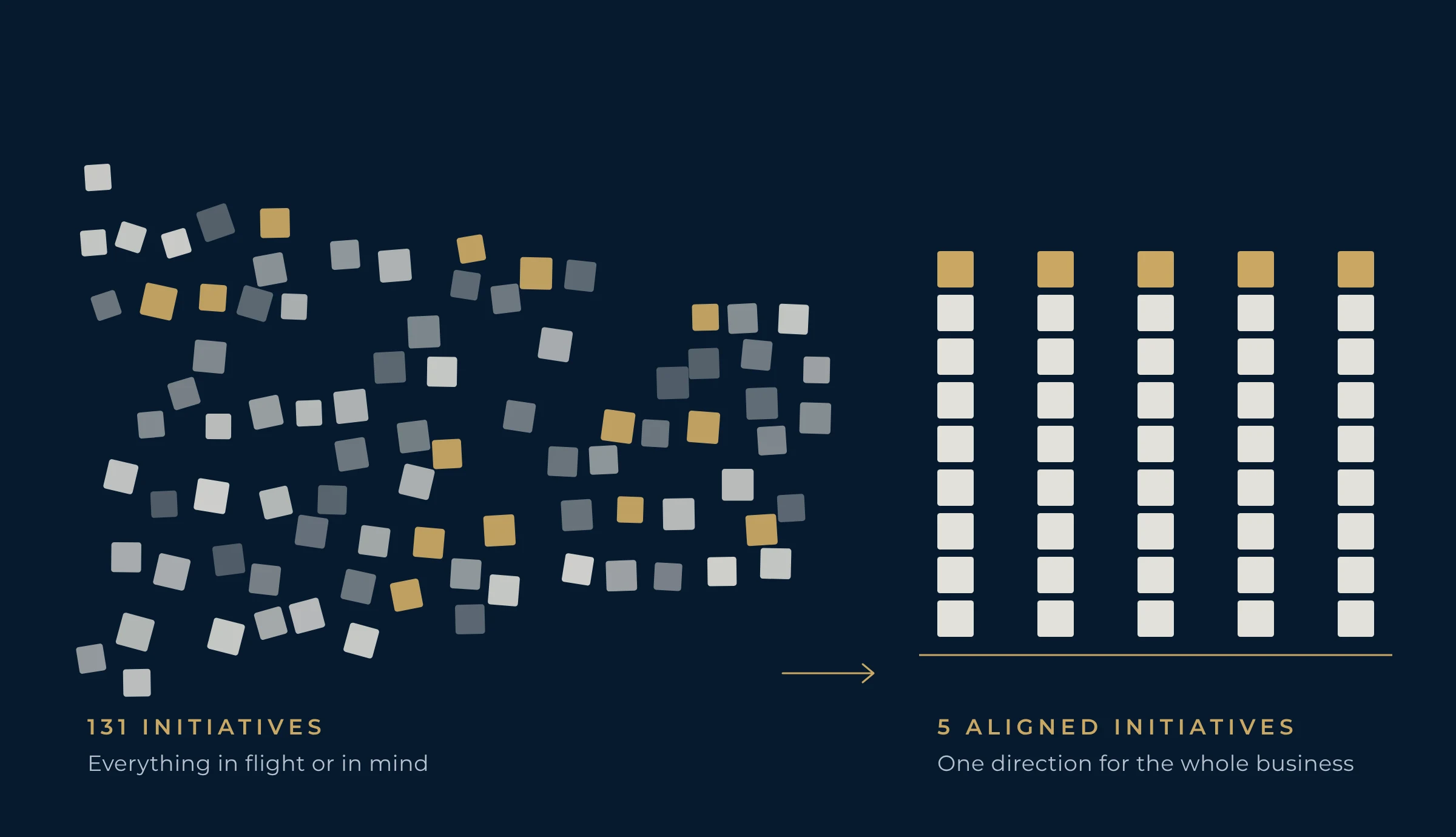
131 scattered initiatives resolving into five aligned initiatives
131 → 5 initiatives focused into five transformation initiatives
18 objectives agreed with executive sponsors
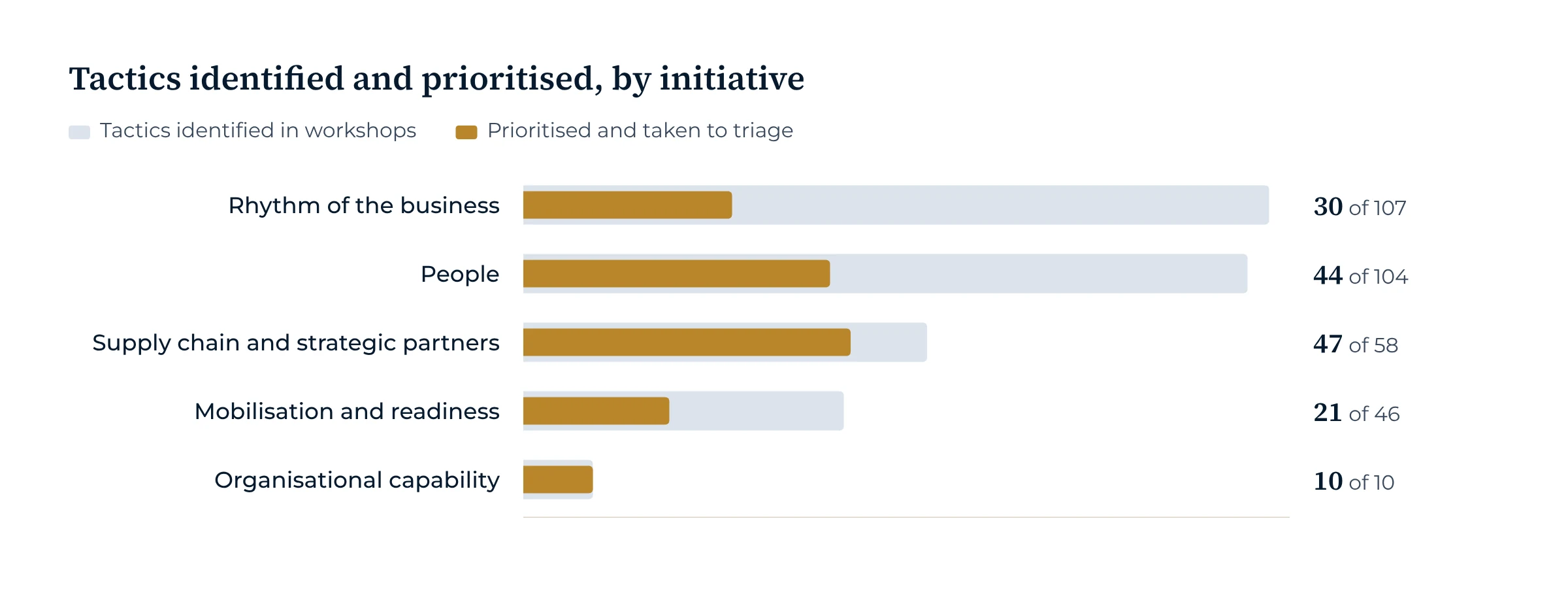
325 tactics created by the people who would deliver them
152 tactics prioritised and triaged for support
The challenge

Growth was coming faster than the business was built for

The business had a strong pipeline and a clear ambition: to grow to roughly twice its size. But it was set up to deliver at its current scale, not its future one.

Teams were busy with well-intentioned initiatives, yet there was no shared view of which mattered most, how they connected, or who owned them. Without firm foundations, growth would simply magnify the problems the business already had.

Five pressures stood out

Organisational capability Structure, planning and decision-making were sized for today’s business, with too much short-term thinking for the pipeline ahead.
Supply chain The supply chain wasn’t ready for planned growth. Strategic partners weren’t defined by discipline, and partners weren’t fully integrated with the business’s ways of working.
Mobilisation Project set-up wasn’t standardised, leading to inconsistent readiness, unclear responsibilities and recurring start-up issues.
Rhythm of the business Siloed data, manual processes and inconsistent reporting made performance hard to measure and harder to control.
People Growth needed more capacity in a competitive labour market, with critical skills to retain and attrition to bring down.
Our approach

Top down to set the direction, bottom up to build the how

Strategy only works if the people delivering it understand it and own it. We started with the executive team, then brought the wider business in to decide how each objective would be met.

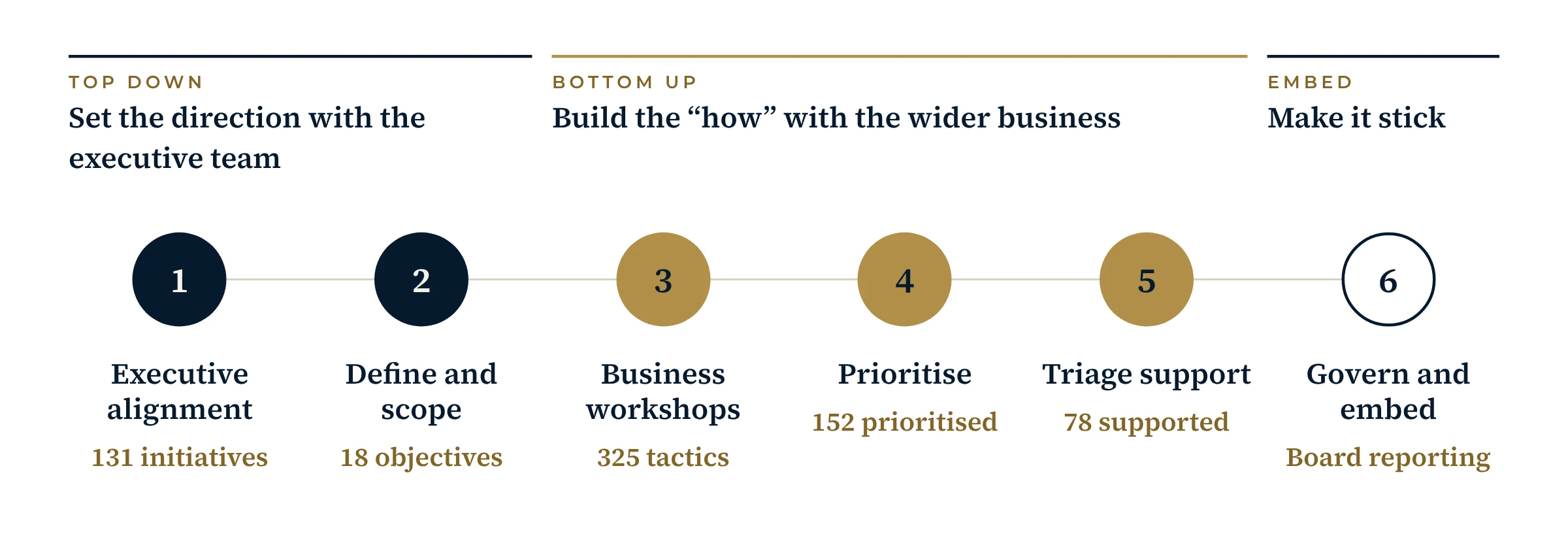
Six steps: executive alignment, define and scope, business workshops, prioritise, triage support, govern and embed
01

Start with the executive team

An executive away-day surfaced 131 live and planned initiatives. A correlation exercise mapped how they depended on each other, revealing 12 categories and 7 themes that the team shaped into five transformation initiatives with 18 objectives.

02

Define and scope with sponsors

Each initiative had an executive sponsor, a goal and clear objectives. Scoping documents set out scope, milestones, dependencies, expected benefits, risks and resources, and 23 were signed off by sponsors.

03

Bring the wider business in

Workshops with the workstreams each sponsor nominated defined the how: 59 strategies and 325 tactics, created by the people who would deliver them.

04

Prioritise what matters

Tactics were scored for impact against effort and cost against risk. 152 went forward to triage, each mapped to one of the business’s four strategic pillars.

05

Match support to capacity

A simple model of none, blended or full support put improvement resource where teams lacked bandwidth. 78 tactics were taken on with direct support.

06

Govern and embed

A programme of works, a maturity model and a fixed reporting rhythm (monthly growth and operations boards, monthly and quarterly executive reviews) kept progress visible and owned.

The framework

One framework the whole business could see itself in

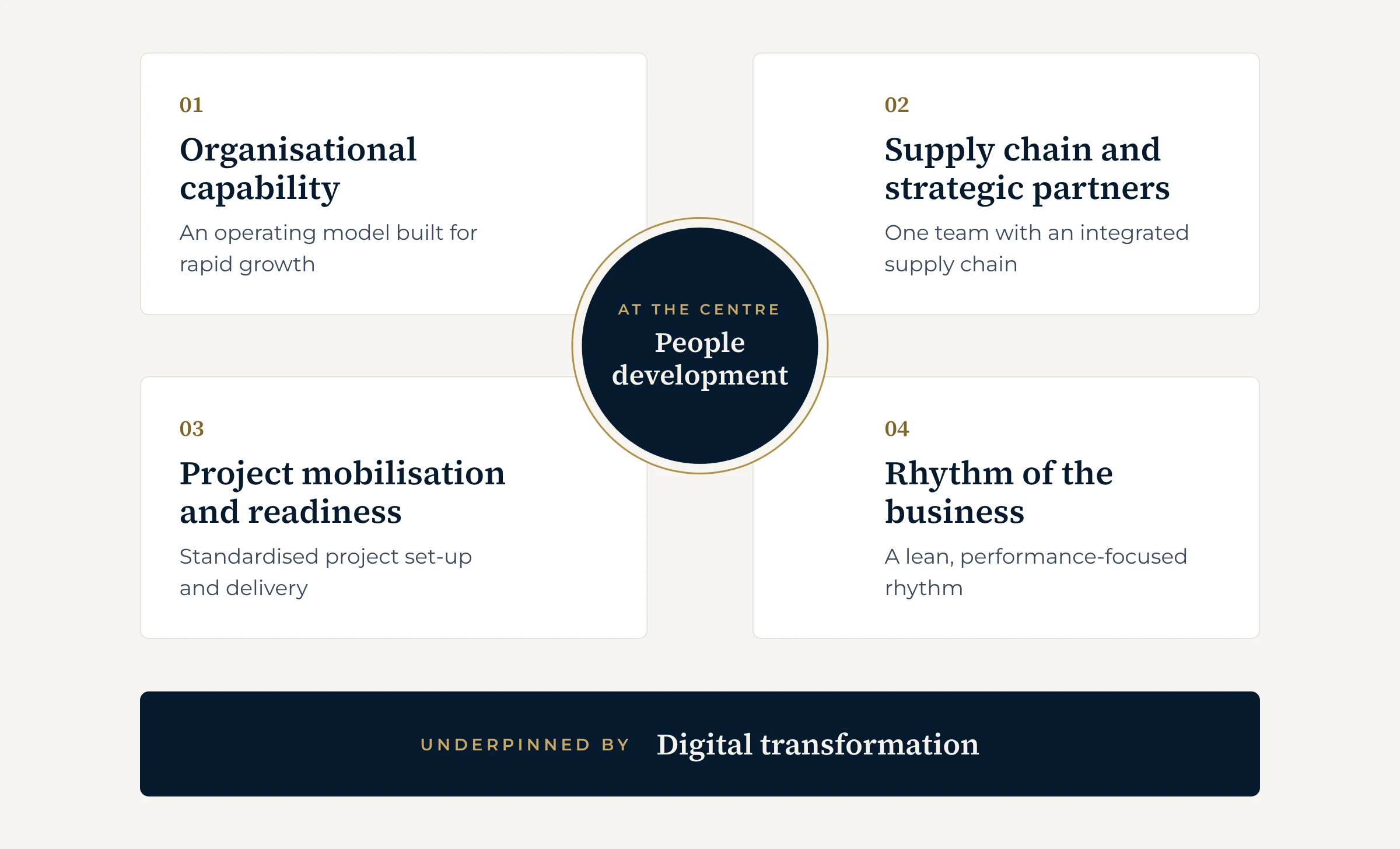
Four transformation initiatives, with people development at the centre and digital transformation underpinning them all. Every tactic traced back to one of them.

Framework: organisational capability, supply chain and strategic partners, project mobilisation and readiness, and rhythm of the business around people development, underpinned by digital transformation
From ideas to action

Focus where it adds the most value

Not every good idea needed doing now. Workshops generated far more tactics than the business could deliver, so each was tested for value before any resource was committed.

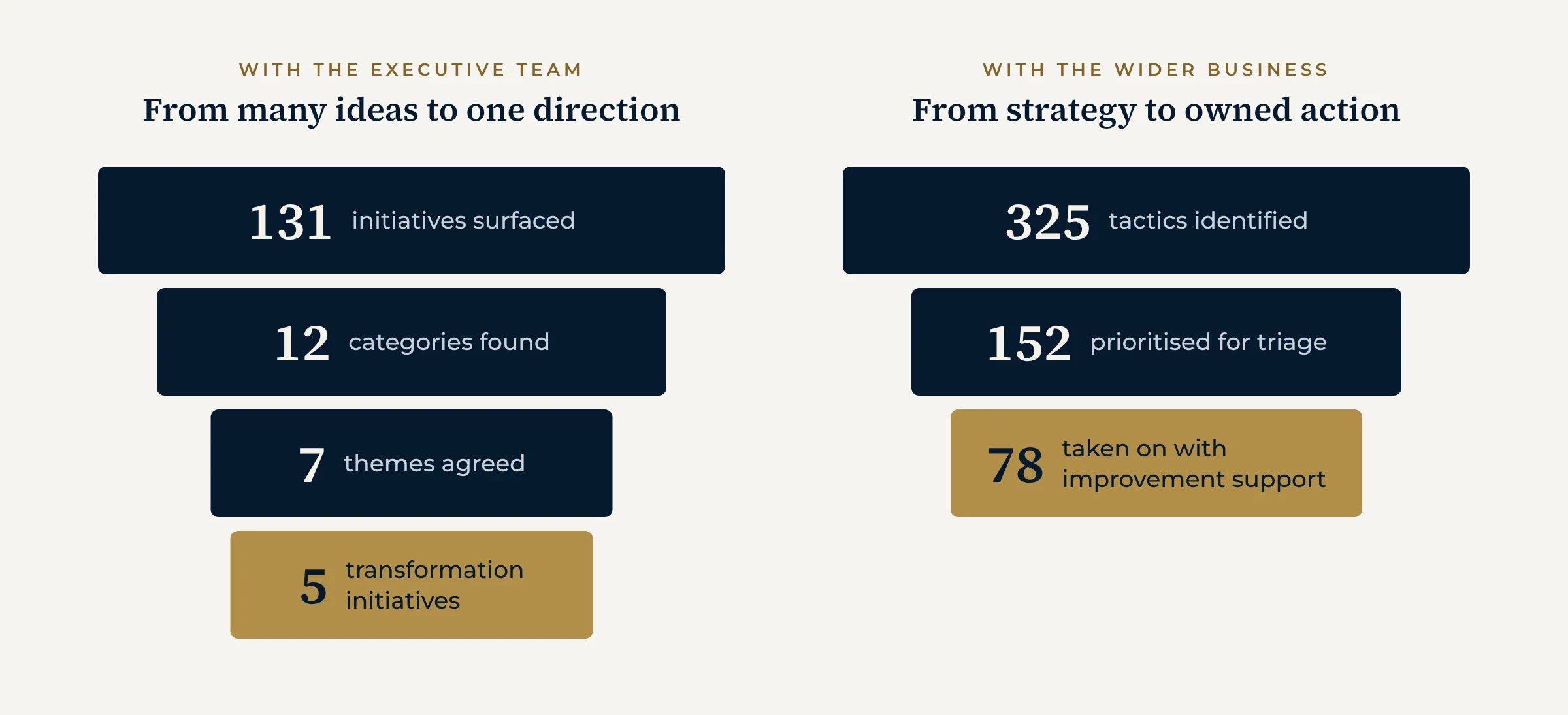
131 initiatives narrowed to 12 categories, 7 themes and 5 initiatives; 325 tactics narrowed to 152 prioritised and 78 supported Tactics identified and prioritised by initiative: rhythm of the business 30 of 107, people 44 of 104, supply chain 47 of 58, mobilisation 21 of 46, organisational capability 10 of 10
What changed

Foundations in place within the first year

Project mobilisation and readiness

A mobilisation guide and plan template built from a review of more than 500 pages of existing guidance, a deliverables tracker and T-minus process, and standard site layouts. The triage gate moved from stage 4 to stage 2 to bring the right people in earlier.

Supply chain and strategic partners

A new labour strategy: 22 agency bids assessed across more than 5,000 data points and shortlisted to five, with a vendor management platform to run external labour from requisition to invoice. Service line spend data was reconciled to within £1K.

Rhythm of the business

Assessments on six projects with more than 30 stakeholders engaged, and a framework validated with subject experts and presented to the executive team, with Last Planner methods and delivery KPIs set as the next step at project level.

Organisational capability

A baseline capacity matrix across the portfolio, supplier categorisation into core, core+ and non-core, and spend-against-forecast data through 2027, giving leaders a fact base for growth decisions.

Client details have been anonymised. Figures are drawn from the engagement’s own reporting.

Why it worked

Four principles we would apply again

01

Start at the top

Direction came from the executive team, so every later decision had a clear line of sight back to it.

02

Let the business own the how

Strategies and tactics came from the people who would deliver them, which built commitment as well as better ideas.

03

Be honest about capacity

Triage matched improvement support to each team’s bandwidth, rather than loading new work onto people already at full stretch.

04

Make progress visible

A fixed reporting rhythm kept every initiative on the agenda of the boards and executive meetings that mattered.

Start a conversation

Planning for growth of your own?

We help construction and manufacturing organisations put the foundations in place before growth tests them. Let’s talk about where yours stand.

Book a discovery call Download this case study